
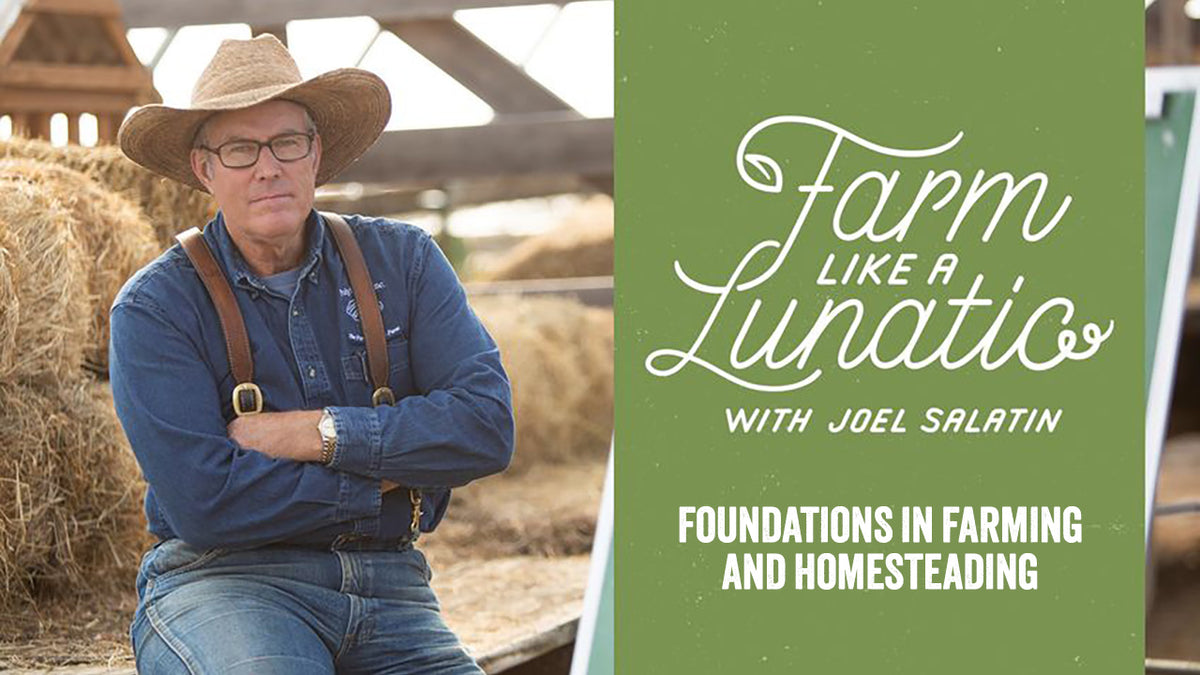

Description
Learn the Skills to Grow Food, Build Self-Reliance & Create Greater Freedom
What if your greatest investment wasn't something you could buy – but something you could learn?
Imagine knowing how to grow your own food, raise productive livestock, build practical systems, and create a more resilient future for yourself and your family.
Foundations in Farming and Homesteading was designed to help you turn the idea of self-reliance into practical action.
In a world of rising costs, fragile supply chains, and uncertainty, the ability to produce, provide, and adapt has never been more valuable.

Build Something You Can Depend On
Led by award-winning farmer Joel Salatin, Foundations in Farming and Homesteading takes you beyond the idea of simply "living off the land."
Learn practical foundations for building a productive homestead or small farm while developing skills that can help you produce food, avoid costly mistakes, and potentially create income.
With more than 60 years of farming experience, Joel shares lessons designed to help you understand the systems behind a successful farm or homestead.
Don't just prepare for the future. Learn how to grow it.

Build a More Resilient, Self-Reliant Homestead
Foundations in Farming and Homesteading is a seven-session journey into self-reliance, food production, homesteading, and practical farming skills.
Each session explores a new area of focus, from building the foundations of a productive homestead and exploring farming as a viable enterprise. Whether you're starting with a backyard flock, planning a homestead, or dreaming of a profitable small farm, this series gives you practical knowledge to help turn your vision into reality.
Here's What You'll Learn by the End of the Course
- Learn how to design your homestead around the land, using water, sunlight, terrain, access, and natural patterns to reduce labor and improve productivity.
- Discover how to build smarter, more resilient systems from housing, fencing, and water to mobile infrastructure that saves time, reduces costs, and adapts as your homestead grows.
- Explore how to make your homestead more productive and profitable by stacking enterprises, tracking profitability, using resources efficiently, and turning livestock into productive partners.
7 Sessions to Turn Your Homesteading Vision into Action

Sessions 1–2: Building the Self-Reliant Homestead: From Dream to Design
What if your greatest investment isn't something you can put in a bank – but something you can learn, build, grow, and share with others?
- Explore how practical skills, knowledge, and relationships can help reduce dependence and build greater resilience in food, energy, housing, health, and finances.
- Learn why relationships and shared expertise can be among your greatest assets – and how surrounding yourself with people who can grow, repair, and build creates a stronger community.
- Discover how living within your means, protecting your nest egg, and making strategic investments can create the financial breathing room needed to build a successful homestead.
- Understand the key factors behind finding the right place to live and farm, including relationships, markets, climate, regulations, taxes, available resources, and future opportunities.
- Learn to observe your landscape, understand water and natural patterns, plan access, and work with the characteristics of your property to create a more productive and resilient homestead.

Sessions 3–4: Designing the Homestead: Housing, Fencing, and Water
Create a more efficient, productive, and resilient homestead by designing your home, land, water, and livestock systems to work together.
- Learn how central placement, proximity to gardens and daily-use areas, hillside construction, and southern exposure can reduce unnecessary work while making your home part of the farm's overall productivity.
- Discover how thoughtful access lanes, fencing, livestock areas, and field layouts can make moving animals and equipment easier while working with the natural terrain.
- Learn why fences and paddocks should follow the land's natural contours and how observing terrain, sun exposure, and moisture patterns can help create more productive and manageable fields.
- Explore practical ways to capture rainfall and surface runoff through ponds and cisterns, store water for dry periods, and use gravity to create efficient water distribution without constantly relying on pumps or hauling.
- Discover simple, practical approaches for tapping springs, transporting water through piping, and developing systems that increase your property's water resilience while reducing energy and labor.

Session 5: Building Smarter: Planning, Avoiding Mistakes, and Making It Work
Build a thriving homestead by focusing on what matters most, taking practical steps, and doing the right things in the right order.
- Learn to start before you feel ready by taking action, embracing imperfect beginnings, and building your skills through experience.
- Discover how to avoid costly mistakes by minimizing unnecessary spending and making practical, strategic investments.
- Explore ways to protect your time and energy by reducing unnecessary trips, movement, and inefficient daily chores.
- Learn how to build stronger relationships by creating clear roles, respecting different personalities, and giving each person meaningful responsibility.
- Discover how to embrace the journey by accepting setbacks, appreciating incremental progress, working with others, and focusing on what truly works for your homestead.

Sessions 6–7: The Mobile Homestead: Building Flexibility, Resilience, and Profitability
Use mobility to create more freedom, resilience, and opportunity on your homestead while growing your farm without unnecessary costs.
- Learn how mobile infrastructure creates flexibility by separating the farm from the land, lowering barriers to entry, and allowing you to scale gradually without tying up your capital.
- Discover how mobility can improve animal health and fertility by using movement, rest, and sunshine to support sanitation while distributing nutrients across the landscape.
- Explore the power of stacking multiple enterprises by rotating different species and activities through the same space to increase productivity, support cash flow, and make better use of your land.
- Learn how mobile systems build resilience by making infrastructure easier and cheaper to repair, adapt, relocate, and recover from unexpected challenges.
- Discover how tracking profitability can strengthen your homestead by separating income and expenses for each enterprise so you can identify what works, improve margins, and make smarter decisions about what to grow or reduce.
Get Lifetime Access
Order your copy today and get instant access to Foundations in Farming & Homesteading.
Here's what's included in the Package:
- 7 Video Sessions (4 hours of video)
- Homework PDFs for each lesson that guide you through the essential steps
- Downloadable PDF transcripts for each video lesson
Included Sessions:
- Session 1 - Dreaming to Grow
- Session 2 - Determining Location
- Session 3 - Designing The Landscape
- Session 4 - Defining The Plan
- Session 5 - Dodging Mistakes
- Session 6 - Developing Mobility
- Session 7 - Deciding Profitability
Start building your skills, confidence, and foundation for a more productive homesteading journey!
About Joel Salatin

Joel Salatin calls himself a Christian libertarian environmentalist capitalist lunatic farmer.
Others who like him call him the most famous farmer in the world, the high priest of the pasture, and the most eclectic thinker from Virginia since Thomas Jefferson. Those who don't like him call him a bio-terrorist, Typhoid Mary, charlatan, and starvation advocate.
With a room full of debate trophies from his high school and college days, 12 published books, and a thriving multi-generational family farm, he draws on a lifetime of food, farming and fantasy to entertain and inspire audiences around the world. He's as comfortable moving cows in a pasture as addressing CEOs in a Wall Street business conference.
Joel has been featured in National Geographic, Smithsonian, Omnivore's Dilemma, Food Inc. and many others.
On his family farm in the Shenandoah Valley, Polyface Farms, Joel produces meat he describes as "beyond organic", which is raised using what the farm describes as environmentally responsible, ecologically beneficial, sustainable agriculture.